Friday, March 23, 2012

Lions Among Men - the Manifestations of Mañjushrī


Namo!  I bow before the Victor’s Son,
Mighty and melodious Mañjugho
ha!
In Ma
ñjushrī, the Wisdom Being—
Consummate embodiment of the Three Jewels—
I constantly take refuge.
Until I reach enlightenments essence,
I go for refuge in the Buddhas.
In the Dharma and the assembly
Of Bodhisāttvas, too, I go for refuge.
Just as the Sugātas,
The Bliss-Gone Buddhas
of the past
Aroused the mind of bodhicitta;
Just as they followed step-by-step
The training of the Bodhisāttvas,
So, too, shall I, arouse the mind of bodhicitta
T
o benefit all those who wander.
So, too, shall I, follow step-by-step,
The Bodhisāttvas training.

Recite this three times.


Perfection of Wisdom,
Your magnificent and melodious speech
Soothes and refreshes all who hear it,
Streaming like a cascading nectar
Down into the mind-streams of beings.

Despite being beyond arising, abiding and ceasing,
And transcending Samsaric rebirth, aging, and death,
You have manifested myriad Nirm
ānakāya,
Emanating amongst us in forms which tame and teach
Due to your unceasing loving-kindness and compassion.

Shantideva, most learnéd of panditas,
Met you face-to-face.
You both recited the Bodhic
āryavatāra
And levitated into space.
May I and all beings,
Whenever we wish to see your smiling face
And call upon your omniscient wisdom,
Likewise be able to view you
With clear seeing and pure vision.
May we proclaim the Lion’s Roar,
The Buddha’s excellent doctrine!


As King Trisong Detsen,
Patron of Secret Mantra,
You invited the Dharma
Into the Land of Snows.
Thus you tamed the Tibetans
And sowed the seeds of salvation
In an entire people,
Ensuring the victory banner would
Fly high on the Roof of the World.
May we join your retinue,
Raising the victory banner
Of practice and instruction.
May all beings live up to your standard
And be transported via the Vajrayana,
Most excellent of chariots.

Sakya Pandita,
Lion of Debate,
Made clear the interrelation
Of patronage and politics.
Refuting wrong views,
Your scholarship was famed far and wide.
Supreme scribe, drinker of ink,
You invented the Pakpa script.
It was you who caused the Khans
To enter the path of Dharma,
Establishing the Vajrayana in Mongolia.
May the Dharma flourish in the ten directions.

Jé Tsongkhapa, Mañjushrī in person,
Most skilled scholar and reformer
Founded the Ganden school.
Thus you ensured the propagation
Of wrathful compassion
In the form of Vajrabhairava,
The Adamantine Terror.
As Yamantaka, Death’s Conqueror,
You subdue the demons of anger,
Terrifying even the most cunning,
Treacherous creatures into practicing.
May I and others subdue all hatred.
And attain the state of deathlessness.
Striking with tough love where necessary,
Yet always with a tender heart,
May we serve sentient beings.

As Jamgön Mipham,
Lama & Protector,
You made your presence known
Through an emanation
Who upheld the unbiased teachings.
May I and all beings be
Unbiased in our sight,
Recognizing all dharmas
As manifestations of emptiness.
All beings and phenomena,
The entire ocean of Samsāra
Is illusion, the wisdom display;
Rainbows and holograms
That dance for our erudition.

Longchenpa, too, was you.
Manifesting as the Infinite,
Vast Expanse of Space,
The treasures of the Profound Secret
Were revealed and clarified,
The Great Perfection expounded.
Brilliant author and tertön,
To you we owe great gratitude.
Your legacy—the Seven Treasuries,
Three Trilogies and Three Essences,
Profoundest of the profound—
Continue to guide and tame.
May we all be guides to those who wander.

Sakya Trizin, Sage of yore,
Wish-granting king of power,
Member of the Family of Conquerors,
You descended from the Celestial Race.
The syllable DHĪH was written
Upon your vajra tongue.
Thus you speak softly,
Teaching the truth,
Imparting skill and knowledge.
May all beings become students
Tamed through enlightened speech.

Drikung Chungtsang,
Holder of the Lion Throne,
Supreme refuge and protector,
You are the transcendent moon,
Reflection of pristine perception.
Lamp of Wisdom & Lord of Speech,
You illuminate the path to liberation,
Shining forth from the Realm of Peace.
May I and all beings be blazing lamps,
Beacons that beckon beings
Out of the darkness of delusion
And into the clear light,
Dispelling all confusion.


Lord Mañjushrī-ghoha,
I carry worldly weapons,
Blades of little mettle.
You hold the Sword of Wisdom
In your heart and in your mind.
Thus you are twice-armed;
None can withstand your onslaught.
In your fearless courage,
You charge headlong into the fray,
Words roaring above the din.
Your keen blade is vajra-sharp,
Able to cut through diamonds,
And blazing with wisdom fire.
Dispel the darkness surrounding my heart!
Slice through the gloomy shadows of my afflictions!
Hack even the slightest obscurations to tiny bits!
Slash all suffering to shreds!
Cleave samsāra into non-dual
ity!

By virtue as pure as the white snow of the mountains,
May the Buddha’s blessings fall upon one and all.


Recite dedication prayers before engaging in the four actions.


Thus Jamyang Sengé earnestly prayed, supplicating and paying homage to all Mañjushrī’s manifestations.  This was composed on the 30th day of the 1st month of the Water Dragon year (i.e. March 23, 2012).  It was translated into the language of the Land of Snows by lotsawa Sherab Zangpo.

This ranting of a madman, the howling of a cat who once died in Dergé, issued forth upon listening to Thubten Sönam Yeshé’s teachings on Mipham’s Sword of Wisdom.  May it not be seen as whining, but a sincere yearning to be one with the yidam and realize the nature of emptiness, thus attaining the perfection of wisdom and realizing the state of Buddhahood.  May all beings become inseparable from the precious guru, Mawey Sengé.

Sarva Mangalam!  May all be auspicious!

Thursday, February 2, 2012

Dharma Ink, Prajnaparamita, and Bodhicitta

Apparently, there is some scriptural basis for putting the Dharma (specifically mantras) on the body, as shown in the following quote.  I came across the following while reading about Avalokiteshvara in a text by Jamgön Mipham Rinpoche.


From the Box Sutra:
The Bhagavat Shakyamuni once said, "It is valuable for beings to hold the name of Avalokita. His great awareness mantra of six syllables was sought for sixteen kalpas by all tathagatas. Even the great mother of tathagatas prostrates to this awareness mantra. 
"Those who hold it and recite it will acquire immeasurable merit. At the time of it's recitation tathagatas and bodhisattvas equal in number to the smallest particles will gather. Millions of buddhas will enter the pores of the reciter of this mantra. They will bestow their approval, saying 'Child of family, you have well acquired something worthy of acquisition. Even all the beings who live in your belly will become irreversible bodhisattvas.' The reciter will be guarded by devas, nagas, yakshas, and others. 
"Anyone who keeps this mantra on their body will achieve a vajra body and a buddha's wisdom. They will acquire all complete qualities, including confidence, wisdom, love, and the paramitas. They will quickly achieve the unsurpassable awakening of buddhahood. 
"Any being who touches or sees this mantra will become a bodhisattva who has reached the end of rebirth. This great awareness mantra pulls out the root of samsara. It guides one to liberation and omniscience. In search of this mantra, one should fill all of Jambudvipa with the seven jewels and offer it. If someone wishes to write this mantra down but lacks ink, it would be excellent for them to use their blood as ink, their skin as paper, and their bones as a pen."
~ pg. 168, [emphasis mine], A Garland of Jewels: The Eight Great Bodhisattvas

It is not lost on me, however, that phrases such as "Anyone who keeps this mantra on their body" could refer to wearing amulets and/or jewelry.  And the part afterwards about using one's blood as ink, skin as paper, and bones as a pen is pretty obviously either meant for high level bodhisattvas (e.g. the Buddha cutting off his head and offering it from the Jataka - tales of his former lives), or as figurative language.


Buddhist texts, whether the holy scriptures of sutra and tantra, or the meditational practice liturgies (sadhanas) derived from them, are so full of metaphorical and symbolic language that one must learn their context and the sacred meanings behind them in order to fully appreciate them... to the point that they are sometimes described as being written in "twilight language."  This is one of the ways in which an unbroken lineage and having a teacher (guru/lama) comes in handy:  as someone who can give detailed explanations and elaborate on the nuances of such texts, as well as providing commentary on how to integrate and implement the meaning in your practice.


That said, it is hard not to see the quote above as scriptural precedent for Dharma body art, at least to some extent.  This seems to be an issue that is being talked about more in recent years, but still there is no firm "yea" or "nay" from many lamas on the subject.  I've heard from one of my own lamas that basically, "It's good to have such aspirations, but this [art] is not necessary.  Better to hold the buddhas, bodhisattvas, and vows in your mind."


Others have been told similar things, asked if it was still OK to get a tattoo even though it's not necessary, and then been told, "Maybe not."  And experienced practitioners have expressed their opinions that having sacred images on the body and then engaging in certain activity is tantamount to engaging in improper conduct with a thangka (religious painting) or rupa (form, i.e. buddha statue), especially in light of the prohibitions of certain behavior based on the vows.


However, based on the idea of the vast amount of merit gathered by simply reciting, hearing or seeing mantras and scriptures in the various Buddhist traditions (and especially in Mahayana/Vajrayana), not to mention writing them, it is hard to see why one wouldn't, if feeling inspired to do so, get the Dharma emblazoned on one's body.


Not only could this serve as a daily reminder for oneself to examine one's mind, engage in good conduct and virtue, refrain from harming beings, and to cultivate compassion and wisdom, but it would obviously be able to serve sentient beings who see such art/text and inquire as to the meaning, bring them to the Dharma, or simply piquing their interest in the subject of Buddhism.  Giving the Dharma --- whether by directly explaining or by helping create the conditions for its development --- is known as the supreme form of generosity, for it aids the mind... and generosity, after all, is one of the 6 transcendent perfections (prajnaparamita).


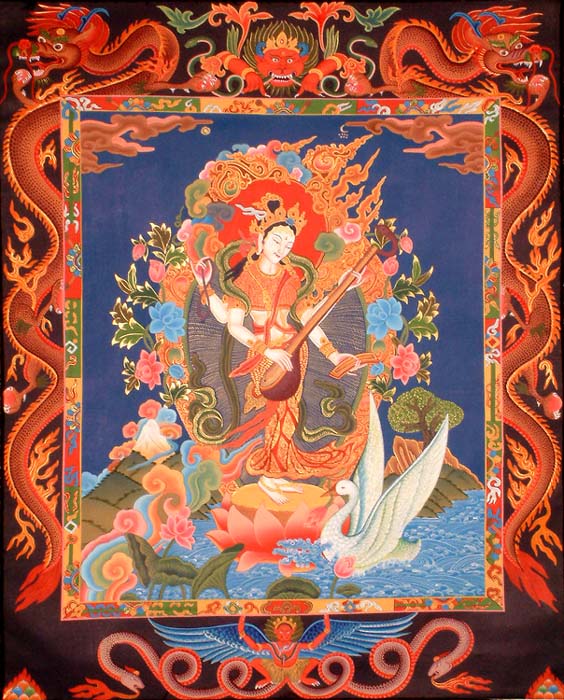
Goddess Prajnaparamita, personification of the Perfection of Wisdom


There list of the Six Perfections:
  1. Generosity (Dana)
  2. Morality (Shila)
  3. Patience (Kshanti)
  4. Diligence (or Joyous Perseverance)
  5. Concentration (or Meditation; Samadhi)
  6. Wisdom (or Insight; Prajna)


Sometimes this list is expanded to Ten Perfections, adding the following to the first six:
  1. Skillful Means (Upaya)
  2. Aspiration (or Resolution, i.e. taking and upholding vows)
  3. Spiritual Power (Bala)
  4. Primordial Wisdom (Jnana; pronounced "Gyana")

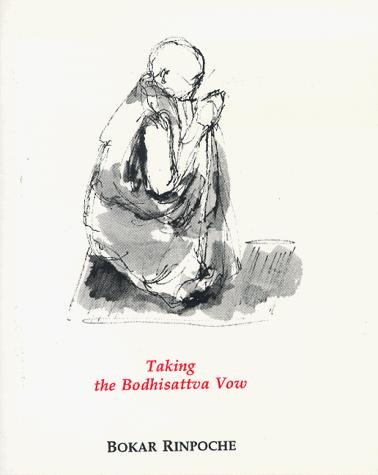
There are many wonderful explanations of and commentaries for these practices and the Prajnaparamita sutras they are named for (i.e. the "Heart" Sutra and the "Diamond" Sutra, as well as the recensions in Eight Thousand, Ten Thousand, Twenty Five Thousand, and One Hundred Thousand Verses).  The best that I have found, getting direct explanation from a living master in person not withstanding, are in Bokar Rinpoche's Taking the Bodhisattva Vow and Khenchen Konchog Gyaltshen Rinpoche's Transformation of Suffering.  I cannot recommend these texts highly enough.


Having received teachings on Prajnaparamita from my root guru (Khenchen Tsewang Gyatso Rinpoche) as my entry into Buddhism, the perfections have a special place in my heart.  From the cultivation of prajnaparamita comes the blossom of bodhicitta (pronounced "bow-dee-cheetah"), the "enlightened mind" or the "mind that turns toward awakening."  And it is only with bodhicitta fully ripened in the mindstream that one can attain the fruit of unsurpassed, perfect, complete and precious buddhahood.


"Khenpo Guru"
Padmsambhava in the flesh


So, why should anyone care about Dharma tattoos?  Are these just the rationalizations of a samsaric mind which wants to adorn the body with symbols of a Buddhist identity?  Perhaps. Perhaps not.  I leave it for you, dear read, to decide for yourself.  This issue, however, has asserted itself in my mind.  As Shantideva says:

"I therefore have no thought that this might be of benefit to others; I wrote it only to habituate my mind.  My faith will thus be strengthened for a little while, that I might grow accustomed to this virtuous way.  But others who now chance upon my words may profit also, equal to myself in fortune."
~ The Way of the Bodhisattva (Bodhicaryavatara), Ch. 1: The Excellence of Bodhicitta
Shantideva, 1 of the 84 Mahasiddhas,
the "Great Saints" of Medieval India

What follows, then, is a description of the latest version of a tattoo design which, someday, I would like to get done, step by step as I walk the path.  In the Tibetan tradition of Vajrayana, there are what are called generation stage practices in which one generates the chosen meditational deity (yidam) in front of oneself, generates him/herself as the yidam, or both, depending on the ritual text being employed.  The practitioner is not merely worshiping an external deity, but rather uses such a practice to.envisions the yidam insubstantially, like a rainbow or a hologram, and to realize that the enlightened nature of such a being is no different than oneself, for the Self is likewise illusory and emptiness is all-pervasive... In truth, all things are interdependent, changing, and relative, whereas we perceive a reality that is solid, stable, and in which things exist independently of each other.  Generation stage yoga, quite simply, is a very skillful method that reminds the practitioner of his/her essential buddha-nature; the ability of all beings, through cultivation, to become buddhas.

"Through this meditation practice, we transform from the completely ordinary state to [that of] a buddha.  The buddhas' compassionate skills interact with the ability and comprehension of the practitioner in this 'spiritual technology' that developed over thousands of years.  Many have been freed from samsara with it."
~ Khenchen Konchog Gyaltshen Rinpoche


Therefore, the idea for this design is to serve as an outward manifestation of the internal generation stage practices in which I am engaged, and to become like a living, breathing thangka as a reminder of the inseparability of myself and the yidam, my buddha-nature; to constantly cultivate the perfections and increase my bodhicitta; and to keep my conduct virtuous with the constant thought that I carry the vows.


Basically, the design is a visual form of the well-known Prayer to Manjushri (Gang-loma):

I prostrate before my guru and guardian,
The ennobling, impeccable Manjushri.
Your intelligence shines forth like the sun,
Free from the clouds of the two obscurations,
Enabling you to see the extent of all things and how they exist:
Thus, you hold a scriptural text to your heart.
Your affection for all of us masses who wander,
   plagued with problems,
Groping in the darkness of ignorance
In the dungeons of our compulsive existence
Is like that for your only child:
Thus, your speech is melodious with sixty facets.
Its thunderous roar arouses us from the stupor
   of our disturbing emotions,
Frees us from the iron chains of our karma,
Dispels the gloom of our lack of awareness,
And slashes our problems wherever they sprout:
Thus, you brandish a sword.
Pure from the core and having traversed the ten bhumis,
Your set of enlightening qualities is complete:
Thus, as a spiritual son of the Triumphant Ones,
Your body is bedecked with the enlightening adornments,
   ten times ten, plus twelve.
Please remove the darkness from my mind.
   O Manjushri, I bow down to you.
OM-A-RA-PA-TSA-NA-DHIH [repeat many times.]
DHIH-DHIH, DHIH-DHIH, DHIH-DHIH [repeat many times.]
Affectionate one, with light-rays of your supreme omniscience
Clear the darkness of naivety from my mind.
Direct me, please, so that confident intelligence emerges within
To comprehend fully the classic texts
   of Buddha's words and the treatises on them.


Right forearm:  Sword of Wisdom; similar in shape to Roman short sword (gladius) with wisdom fire, mantra, and vajra hilt.


Sword of Wisdom


Right shoulder:  Swayambu stupa, a pilgrimage site in the Kathmandu Valley of Nepal and sacred place of Manjushri; when one does circumambulation of stupas, they are supposed to be kept on the right side and walked around clockwise... This would allow me, as described in certain texts, to imagine myself always circumambulatin the stupa to my right.


Swayambhu stupa, built on the lotus which rested in a lake,
drained after Manjushri cleaved a gorge with his Sword of Wisdom;
the result of which was the Kathmandu Valley


Left arm:  the long stem of a lotus, winding and creeping up my arm, composed of the Tibetan script for the six perfections, which culminates in the word for bodhicitta and then blossoms into a blue lotus upon which rests a Tibetan-style text: the 100,000 verse Prajnaparamita Sutra, symbolizing that buddhahood and bodhicitta stem from the prajnaparamita.


Lotus Blossom


Lotus Stem


Chest:  the mantra of the 100,000 verse Prajnaparamita Sutra, also known as the Mantra Encompassing the Essence of the Kangyur (the Tibetan name for the group of scriptures known as the Words of the Buddha), illuminated by a lotus in the middle surmounted by a sun and moon disc and the seed-syllable of the Manjushri/Prajnaparamita mantra.


Illuminated Text


Back:  the Bodhisattva vows in Tibetan script, as formulated in Shantideva's Way of the Bodhisattva:


Vows
Until I attain the heart of enlightenment, I take refuge in all the buddhas.  
I take refuge in the Dharma and likewise in the assembly of the Bodhisattvas. 
As the previous buddhas cultivated the enlightened mind and progressed on the bodhisattva's path,
I, too, for the benefit of all sentient beings, give birth to bodhicitta and apply myself to the stages of the path. 


As with anything pertaining to the Dharma, I end this entry with a prayer of dedication.  Recently it was brought to my attention that one of the reasons we have been fortunate enough to encounter the Dharma is due to vast stores of merit, but that the reason this has not led to enlightenment yet is because, amongst other things, we did not dedicate the merit of our practice properly.
By this beneficial activity may I obtain Omniscience, and having vanquished the harmful enemies (greed, anger, and delusion), may I liberate all beings tossed about helplessly by the waves of birth, aging, illness, and death in the Ocean of Becoming.
By conforming to the knowledge of courageous Manjushri (Jampälyang) and in the same way as Samantabhadra (Küntuzangpo), and following their example, I dedicate perfectly all this virtue.
By this virtue may all beings perfectly achieve the accumulation of Merit (Sönam) and Wisdom (Yeshe), and may they thereafter obtain the two holy bodies which result from these two accumulations.
By the blessings of the Buddha (Sangye) who obtained the three bodies; by the blessings of the immutable truth of the Dharmata (Chönyi); by the blessings of the infallible aspiration of the Sangha (Gendün), may this prayer of dedication be accomplished just as it is.

Sarva Mangalam!  May all be auspicious!


Sarasvati, Goddess of Learning, Literature, and Poetry

Sunday, September 11, 2011

In Memoriam: Love is Counter-terrorism

Today is the 10th anniversary of the terrorist attacks on 9/11.  Amidst all the memorials, documentaries, and solemn ceremonies which have been aired and held and will continue throughout the day, I would like to say some things which might lend a slightly different take on the suffering felt on that day and since, and what we can do about it.


Back in 2001, I was a 14-year-old freshman in high school.  I still remember passing between classes on campus and being told by a girl whom I barely knew that a plane had crashed into the World Trade Center in New York, and arriving at my Physical Sciences class to spend the whole time glued to the TV coverage as the 2nd plane crashed into the 2nd tower, another hit the Pentagon, and the last crashed into a field in Pennsylvania.

It was terrifying and heart-wrenching, and yet I also remember being selfishly thankful that the terrorists hadn't struck where the President actually was that day.  He happened to be in my hometown of Sarasota, FL, reading a book to a class of schoolchildren.  Had they only known, I thought, there would be planes falling out of the sky over my head.  And then there was the moment of silence a day or so later, led by the head student officer of our school's ROTC, who denounced the attacks and declared her love for her country as a Muslim and proud prospect for the military.

In many ways, 9/11 was a seminal moment.  It's a day that will go down in infamy, much like the attack on Pearl Harbor which spurred on our entry into World War II.  It was the genesis for 2 wars that still continue to this day, and have claimed thousands of lives --- terrorist, military, and innocent --- on both sides of the equation.  But it was also a moment in time that brought out, simultaneously, the best and worst of us.


While some of us wanted peace and saw this as all the more reason that the world needed it, more wanted revenge and war.  According to some of the documentaries I saw last night, many even wanted this war of retribution so badly that they didn't care about the civilian casualties it would cause.  An eye for an eye... Innocents for innocents.

We heard of the selflessness in the actions of those who helped those around them escape the towers and the self-sacrifice of the passengers of Flight 93 in order to ensure more lives weren't lost. We saw the compassion-in-action of emergency responders who rushed into those towers in order to do anything they could despite the risk, many of their lives being claimed in the process of trying to help.  And we saw all the rescue workers and their dogs tirelessly wading into the rubble to try and find survivors, day after day.


Those who survived the attacks and those who volunteered themselves to searching and clearing the ruins of the towers --- firefighters, police, rescue workers and construction workers alike --- subjected themselves to tons of health hazards which we are only now starting to understand.  The dust and smoldering rubble have claimed more lives since, and continue to plague many of those who survived.  Appallingly, while the toxic plume that these brave souls endured contained a perfect cocktail of carcinogens, cancer treatment is not covered in the current Zadroga health plan for free medical coverage for responders and survivors who were exposed.*

There was a tremendous outpouring of support, sympathy, empathy, and giving.  But along with that, there was a tremendous surge of distrust and hatred toward our Arab and Muslim neighbors.  Tons of hate crimes and hate speech --- violence, discrimination, and harassment --- has stemmed from this one event.  Religious discrimination, such as a city's opposition to a mosque, discrimination in the workplace and verbal harassment, are all part of the fallout.  Merely to be perceived as an Arab or a Muslim based on the color of your skin or the wearing of a turban can lead to trouble, putting Sikhs, Hindus, and other religious and ethnic groups in danger of the same mistreatment.^


I can't lie... In the aftermath I wanted us to strike back and take out those responsible, and became increasingly suspect of Muslims.  Whenever I saw a woman dressed in hijab, I felt nervous.  I didn't know any Muslims personally, and the social and political environment was increasingly hostile.  While I knew better, having been subject to discrimination and hate due merely to my Jewish background, the combination of my ignorance and the uproar saw me swept up in the prevailing sentiment.  Then, a few weeks after the tragedy, a bunch of celebrities participated in The Concert for New York City, a televised benefit and memorial to the victims.  Richard Gere's speech struck me as particularly inappropriate.


"The horrendous energy that we're all feeling, and the possibility of turning it into more violence, and revenge --- we can stop that. We can take that energy and turn it into something else. We can turn it into compassion, and to love, and to understanding...  That's apparently unpopular right now, but that's alright."

He wanted peace for all sentient beings.  I didn't think that the terrorists or those who sponsored them deserved it.  Back then I wasn't Buddhist and didn't really know anything about the religion, nor religions in general.  Gere was crazy and off-putting for being so calm and seemingly unaffected by the tragedy.

In the ten years since, I have come to see the wisdom and value of Gere's words, which represent his Buddhist worldview.  My reaction then and my reaction now are vastly different.  I'm almost on the complete opposite side of the spectrum.  Having become Buddhist and decided to study the various faiths, I have come to understand that the religions of the world all have their worth in seeking to provide guidance and a moral blueprint for humanity.


Extremism doesn't exist solely in Islam, despite what we are led to believe by the misinformation and paranoia which are often propagated in this country by the media and others.  Extremists can be found in those claiming to be practitioners of all the various traditions.  Anyone who firmly believes they have the right to claim they are the sole holders of the truth, and that all others are subject to hate, violence, and/or persecution as unbelievers is dangerous.

Muslims, in fact, are some of the most intelligent, kind, and tolerant people I've met.  I am proud to have several amazing Muslim women as my friends, including an ex-girlfriend who I considered marrying and having children with.  All of them have helped educate me on Islam and opened my heart.  They are constant reminders of courage, perseverance, and warmheartedness in the face of adversity, persecution and fear.

Now, instead of being nervous whenever I see a girl in traditional Muslim garb, I smile.  She probably gets plenty of nervous glances and hateful stares just based on the way she's dressed, through no fault of her own.


Despite being Jewish by birth, I now don't automatically side with Israel and denounce all its neighbors and those who oppose it, not out of a new found self-hatred, but out of a more nuanced understanding.  While I find it deplorable, I can understand how children come to be supporters and even members of groups like Hamas and Hezbollah.  Such groups recruit underprivileged youth who are deprived of things like clean food and water, shelter and hygiene facilities, and lead them to believe that Israelis and Americans don't care for them or seek to keep them down.+

No matter where extremism and terrorists are, it all boils down to what we cultivate as a culture and as individuals, and with what values we instill when we raise our children.  If we were to encourage love-kindness, tolerance and compassion for all beings instead of hate, competition, and indifference, how much kinder a world would the we have?

So what can we, as individuals, do?  Often I have heard, and even expressed, a frustrated sense of being unable to change the world all by one's lonesome.  The truth is, none of us are alone.  Everyday, we touch the lives of others and are ourselves touched, and such interactions have effects and consequences far beyond our scope to see.  We are constantly inspiring and informing those around us, caught up in a worldwide web of interdependent thoughts, words, and actions.  Indeed, as the Buddha said:

"The thought manifests as the word.  The word manifests as the deed.  The deed develops into habit, and the habit hardens into character.  So watch the thought and its ways with care, and let it spring forth from love, born out of concern for all beings."

Therefore, what we should do in memory of those whose lives were lost or given, and in response to those responsible, is strive to value peace over war, love rather than hate, and show compassion for those who are suffering... not just today, but everyday of our lives.


For my part, I will meditate and pray, and make an effort to attend a film called The Power of Forgiveness showing on campus tonight.  I leave you with two quotes that say what I believe in my heart much better than my own words can.  Hopefully you will take them to heart, too.  Remember:


"Hatred does not cease by hatred, but only by love; this is the eternal rule."
~ The Buddha
"World peace must develop from inner peace.  Peace is not the absence of violence.  Peace is the manifestation of human compassion."
~ The Dalai Lama

-------------------------------
* = See the documentary CNN Presents:  Terror in the Dust

^ = See the documentary CNN Presents:  Unwelcome - The Muslims Next Door; the FBI's hate crime statistics report 2002; and Harvard University's Pluralism Project research report on Post 9/11 Hate Crime Trends

+ = See the documentary film Promises

Thursday, January 20, 2011

Welcome Back, Lama

This past week Khenchen, the first lama i ever met and received teachings from --- who effectively sealed the deal on me becoming a Buddhist --- returned to the Pensacola area to give another set of teachings @ Palyul Changchub Chöling (Gulf Breeze Dharma Center).

Khenchen Tsewang Gyatso Rinpoche, senior abbot of Palyul Namdroling monastery

This trip back to Pensacola was very productive.  I spent a good deal of time at my lama's side, whether it was getting Khenchen's blessing to become a translator and his practical advice on how to stick with that goal, or painting the butter sculpture offerings (torma) for the Guru Rinpoche day feast (tsok) and helping hold/cut the Mahakala text, or getting all my religious paintings (thangka) and statues (buddharupa) consecrated... Whatever i was doing, it was either in the lama's presence and we were laughing, or i was carrying the lama with me in my mind.  This must've been a taste of truly living in the present moment.  In a word:  inspiring.

While obligations to school and work (and a slight lack of planning) led to me being unable to attend the entire week, i was able to receive teachings on Mipham Rinpoche's Sword of Wisdom and an empowerment, retake refuge, and repair my individual liberation (pratimoksha) vows.  Let me take a minute to break it down.


The vows of pratimoksha (Skt. pratimokṣa-saṃvara; Wyl. so thar gyi sdom pa) or vows of ‘individual liberation’ (Skt. pratimokṣa; Wyl. so sor thar pa) mainly emphasize disciplining one’s physical behaviour and not harming others.

Pratimoksha discipline is called the foundation of Buddhism because for ordinary people physical discipline is the beginning of spiritual training and the basis of spiritual progress. The aspiration of the pure pratimoksha discipline is the achievement of liberation for oneself, as it belongs to the shravaka training. However, since Tibetan Buddhists are automatically followers of the Mahayana, they emphasize taking the pratimoksha vows with the attitude of bodhichitta.
~ RigpaWiki.org

The Five Pratimoksha Vows for Laypeople (Non-monastics):
  1. to refrain from killing
  2. to refrain from stealing
  3. to refrain from lying
  4. to refrain from sexual misconduct
  5. to refrain from taking intoxicants

As they were explained to me, the first 4 are considered root vows, and the 5th regarding intoxicants is considered a branch vow.  This means that transgressing the first four directly leads to non-virtuous action, whereas something like drinking alcohol is not inherently non-virtuous, but rather being unmindful while becoming intoxicated is what leads to non-virtuous action.  Pratimoksha vows are like a clay pot:  if they are minorly transgressed, such as in an instance where one's motivation is pure and one is helping protect another sentient being from harm, the pot gets scratched.  If one wantonly transgresses and/or motivation is not pure, the vows are broken and the pot shatters.  Having taken them before and transgressed, i therefore decided to retake the vows and get a new clay pot that i'll be be much more careful with.  A new year, a fresh start.


Sunday, January 2, 2011

Kindness of Strangers, part 2

Shortly after the interaction mentioned in the previous entry, i came across a note made during a teaching in September (the first teachings i received after returning to the U.S. from India & Nepal at the end of August)... Teachings given by His Holiness Chetsang Rinpoche --- current head of the Drikung Kagyu lineage of Tibetan Buddhism.


Amongst the 11 pages of sticky notes from the empowerments of Five-fold Mahamudra and Great Bodhichitta, there was this:

The Four Immeasurables
Loving-kindness (the joyful aspect)
Compassion (the rough/uneasy aspect) 
Joy 
Equanimity
Lord Jigten Sumgon says loving-kindness is easier to practice regularly.

Lord Jigten Sumgon's Pith Instructions on the Experience of the Four Immeasurables:
Loving-kindness like ones feels for a beautiful child (marveling at every action).
Compassion like one feels for a leper. 
Joy like one feels when reunited with loved ones.
Equanimity like one feels just on the verge of sleep.

Lord Jigten Sumgon, founder of the Drikung Kagyu lineage

Read this and realized just how profound the teachings were, if these are my mere paltry notes on what was given.  Truly didn't appreciate them until recently.  It's just now starting to click...

Tuesday, December 28, 2010

Kindness of Strangers

Setting:  Yesterday.  Approx. 4:00 PM.  A cold Tallahassee day.  The city bus depot.


Enter a lone man who sits on the bench to eat his Popeye's chicken wrap, biscuit, and sip his Mountain Dew.  Across from him sits a mother and her child.  The mother is white, her daughter either adopted or of mixed race.  The most precious little girl, playful and talking cutely about whatever strikes her mind.  Innocence.

All three of us are bundled up, so after my meal is finished I asked "How old is he?"  After being corrected by the mother and apologizing for the mistake due to how covered we all are, the mother replies that it's fine and that she is 5.  She reminds me of my own little sister, Allison, who is now 8, but whom I got to see grow up from a newborn and in various stages of her life (one of them when she was precisely this age).

Thanks to the widening of my circle of compassion due to my now daily practice and meditation, I feel for this mother and child as if they are my own mother and sister.  We talk as if we've known each other like old friends, and I say the same little comments I would to Allison.

"Five years old?  You're getting big!"
...
"Pretty soon you'll need your own purse."
Etc., etc.

After about 20 minutes of conversation, their bus arrives just before mine.  We say goodbye to each other, no names exchanged.  The little girl, for no particular reason --- and as if to restore my faith in humanity (which, of late, has sometimes been called into question) --- runs up to me and gives me a big hug before running onto the bus.

Such moments remind me of the buddha-nature of all sentient beings, and make my heart smile :)

Friday, December 24, 2010

Death, the Great Motivator

Written 12/23/10:


All that is born must inevitably die.  This is the natural order of things.


Last night I learned that my grandmother, Janice Estelle Rosenfeld, passed away peacefully in her sleep at the age of 86, exactly 360 days after my grandfather.  In surveying what I had done yesterday while my grandma had been going through the death process, I came to a comforting realization.  When my Aunt had finding her body in Pennsylvania, I had been quite early and waiting patiently for an appointment in Florida, and so I made another appointment with myself.  I had been meditating.


When I came home and found the message from my Aunt, I didn't have to open it to know what it said.  Janice had passed.  What I felt, instead of grief, was immediate compassion for her and for my family.  I told my brother and hugged him, telling him I was here if he needed to talk or cry.  I thought of my father and how he would take it, being a world away in the Philippines, and having already experienced the deaths of his father and brother over the course of the year.  Rather than be brought low by loss, I took it for a lesson in impermanence and as a great opportunity to practice and cultivate bodhichitta --- the mind of awakening which evokes compassion for all sentient beings.  The definition of compassion, according to the Buddhist tradition, is the feeling of not wanting beings to suffer.


And then it dawned on me.  What had I been doing just the weekend before?  None other than receiving teachings on the intermediate states (bardos), including the bardo between death and rebirth.  Not only that, but also being given empowerment to practice on Amitabha, the Buddha of Limitless Light, and how to eject one's consciousness into Amitabha's pure realm of Dewachen, where one can then practice dharma constantly until enlightenment.I had almost not gone, but a spiritual friend had decided to drive all the way to Tampa for a single day, and I had jumped at the chance to see the lama.  After some debate with myself, I had decided to stay an extra day.  And boy am I glad that I did, for now those teachings are being put to good use.


Never before have I been so motivated to practice.  This morning marked the first of 49 days in which I can be of assistance to my grandmother while she wanders in the bardo of becoming, before she takes another rebirth.  I started my practice at 7:30 a.m., and before I knew it the clock said it was 11:45.  Four hours of prayer, punctuated by meditation... Now, more than ever before, I feel better equipped to be of benefit to her and all sentient beings suffering in samsara.


In the wise last words of the Buddha:  "Impermanent are all compounded things.  Strive on heedfully."


Namo Amitabha!